15. Multimodal & Vision-Language
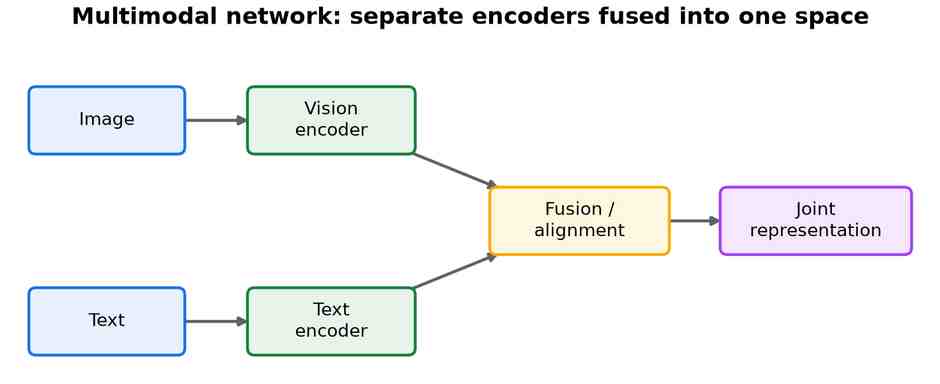
A multimodal network handles more than one kind of input at once — most often images together with text. The standard recipe, in Fig 17, encodes each modality with its own network — a convolutional or vision Transformer for images, a Transformer for text — and then fuses or aligns the two representations into a shared space.
Origins and rise
CLIP aligned images and captions with a contrastive objective — the same metric-learning idea applied across modalities — and unlocked zero-shot classification from natural-language labels.[208] Flamingo then showed few-shot visual question answering by feeding image features into a frozen language model.[209] The same encoders feed the generative text-to-image systems that turn a prompt into a picture.
Image-text alignment
CLIP's contrastive recipe[208] was quickly scaled and refined. ALIGN showed that a noisy billion-scale web dataset could stand in for careful curation,[210] LiT found that locking a pre-trained image encoder while tuning only the text tower gives stronger zero-shot transfer,[211] and SigLIP swapped the softmax contrastive loss for a simple pairwise sigmoid that trains well even at small batch sizes.[212]
Fusion encoders for question answering
Before contrastive pre-training, visual question answering was driven by attention over detected objects: the Bottom-Up and Top-Down model attended to region features from an object detector.[213] The BERT era then produced Transformer encoders that fuse the two modalities directly: ViLBERT used two streams joined by cross-attention,[214] LXMERT a comparable cross-modality encoder,[215] and UNITER a single stream that concatenates image regions with word tokens.[216]
Generative vision-language models
The next wave connected vision encoders to generative language models so the output is free-form text. BLIP bootstrapped noisy web captions to pre-train for both understanding and generation,[217] and BLIP-2 bridged a frozen image encoder to a frozen large language model through a lightweight querying transformer.[218] Flamingo interleaved image and text tokens for few-shot prompting,[209] while PaLI jointly scaled the vision and language towers across many languages.[219]
Visual grounding
Grounding models tie phrases to specific image regions. MDETR extended the DETR detector[23] to condition detection on a free-text query,[220] and Grounding DINO married a strong detector with grounded pre-training for open-set detection from arbitrary prompts.[221] Kosmos-2 folded grounding into a multimodal language model, letting it point to regions as it generates text.[222]
Document understanding
A specialised branch reads text-rich images such as forms, receipts, and screenshots. LayoutLMv3 jointly masks text and image patches to learn layout-aware representations,[223] while Donut reads documents OCR-free, decoding structured output straight from pixels.[224] Pix2Struct pre-trained by parsing masked webpage screenshots, transferring to charts, user interfaces, and diagrams.[225]
Unified any-task models
The frontier folds every task into one sequence-to-sequence model. CoCa trained a single network under both contrastive and captioning objectives,[226] and Unified-IO cast vision, language, and dense prediction tasks into one shared token vocabulary.[227] BEiT-3 treated images as another language to pre-train a shared backbone across vision and vision-language tasks,[228] and ImageBind learned a single embedding space binding six modalities using only image-paired data.[229]
Applications
- Text-to-image retrieval and zero-shot classification.
- Visual question answering, captioning, and document understanding.
- Open-vocabulary detection and multimodal assistants.
Strengths and limitations
| Strengths | Limitations |
|---|---|
| Transfer to new tasks with no fine-tuning. | Need enormous paired image-text datasets. |
| One model spans several modalities. | Inherit and can amplify dataset biases. |
| Enable open-vocabulary, language-driven tasks. | Expensive to train and to serve. |