19. Set & Permutation-Invariant Networks
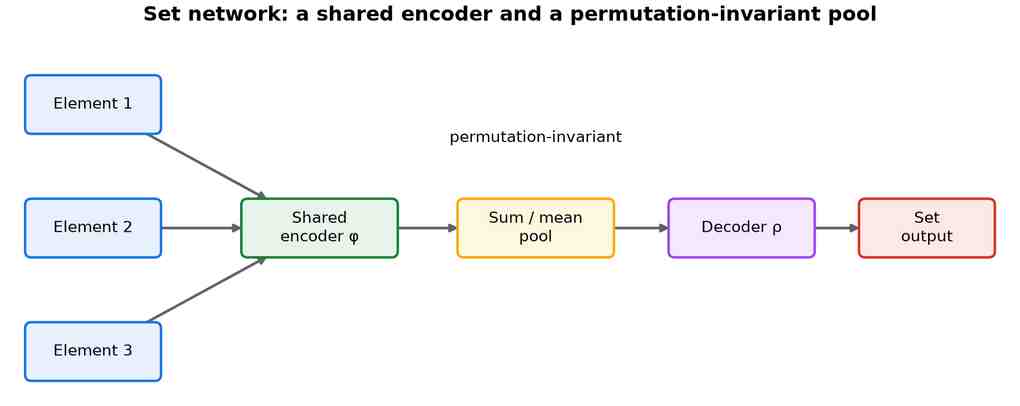
Some inputs are genuinely sets — a bag of items with no meaningful order. A permutation-invariant network, in Fig 21, encodes every element with a shared function, pools them with a symmetric operation such as sum or mean, then decodes the result; swapping two elements cannot change the output.
Origins and rise
Deep Sets proved that any permutation-invariant function can be written in this encode-pool-decode form, giving a clean sufficient condition: the element encoder must map into a latent space rich enough that summation there loses no information.[284] The Set Transformer then replaced simple pooling with attention between the elements, capturing interactions a plain sum cannot represent.[285] The same pooling idea underlies point-cloud and graph networks, and it is also the implicit backbone of modern aggregation in vision-language token pooling.
Beyond sum-pooling
A plain sum or mean is invariant but throws away how elements relate. Janossy Pooling spans the whole spectrum between the two extremes: it averages a permutation-sensitive function over orderings, and by restricting to k-ary sub-permutations it trades expressivity for cost — at k=1 it recovers sum-pooling, at full k it becomes an order-sensitive model averaged over all permutations.[286] RepSet takes a geometric view, comparing each input set against learned hidden sets through a Hungarian bipartite-matching problem so the pooled representation reflects correspondence rather than mere co-occurrence.[287] These designs are motivated by a theoretical limit: sum-pooling can represent any set function only if the latent dimension is at least the set size, so a small bottleneck provably loses information.[288]
Predicting sets as output
Producing a set is harder than consuming one, because any fixed output ordering fights the target's permutation symmetry. Deep Set Prediction Networks sidestep this by predicting a set through an inner gradient-based optimisation whose loss is itself permutation-invariant.[289] Slot Attention instead learns a small number of interchangeable slots that compete, via attention, to bind to parts of the input, giving an object-centric set representation that generalises across scenes with different object counts.[290]
Applications
- Point-cloud and multi-object reasoning.
- Statistics and predictions over variable-size collections.
- Pooling inside graph and few-shot models.
Strengths and limitations
| Strengths | Limitations |
|---|---|
| Exactly invariant to input order. | Simple pooling loses element interactions. |
| Handle variable-size inputs. | Attention pooling costs grow with set size. |
| Small and general-purpose. | Cannot represent order when it does matter. |