27. Domain-Specific Architectures
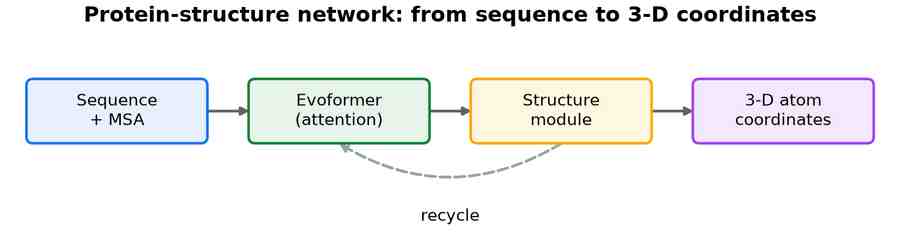
Some of the largest breakthroughs are architectures tailored to a single domain. AlphaFold, in Fig 29, predicts protein structure by turning a sequence and its evolutionary relatives into pair features, refining them with attention (the Evoformer), and reading out 3-D atom coordinates — an accuracy leap on a decades-old problem.
Origins and rise
AlphaFold combined attention over residues and residue pairs with a structure module and iterative recycling.[340] In other domains, TabNet brought attention-based feature selection to tabular data,[341] and vision-language-action models such as RT-2 repurposed multimodal Transformers as robot policies.[342]
Tabular deep learning
TabNet brought sequential attention to tabular data, selecting features per example for both accuracy and interpretability[341] while NODE generalised gradient-boosted trees into an end-to-end differentiable ensemble. The FT-Transformer and SAINT lines show that Transformer-style attention over columns, with intersample attention, can rival or beat gradient boosting on mid-sized tables.
Code generation
Programming languages are sequences too. CodeBERT extended masked-language pre-training to the bimodal code-and-text setting, and CodeT5 cast code understanding and generation into a unified text-to-text framework.[343] AlphaCode scaled the same Transformer backbone with massive search and filtering to solve unseen competitive-programming problems, pointing toward systems that write software from a natural-language specification.
Protein and molecular structure
Perhaps the highest-impact domain-specific architecture is AlphaFold 2, whose Evoformer exchanges information across pair and multiple-sequence-alignment representations to predict 3D protein structure at experimental accuracy.[340] RoseTTAFold offered a three-track alternative, and the ESM and ProtBERT protein language models bring the masked-pretraining recipe from natural language to amino-acid sequences, learning structure and function without labels.
Robotics and control
Robotics policies increasingly use large Transformer backbones. RT-1 showed that a vision-language-action Transformer can map camera input and natural-language commands to robot actions, and RT-2 demonstrated that co-fine-tuning a VLM on web-scale vision-language data and robot trajectories yields emergent semantic generalisation on the robot.[342] SayCan grounds a language model's proposals in affordances learned from the robot itself, chaining skills into long-horizon plans.
Applications
- Protein-structure and molecular modelling.
- Tabular prediction in finance and healthcare.
- Language-conditioned robotic control.
Strengths and limitations
| Strengths | Limitations |
|---|---|
| Superhuman accuracy within their niche. | Narrow, with heavy domain engineering. |
| Encode domain priors directly. | Need large, curated datasets. |
| Reuse attention and multimodal ideas. | Expensive to train and adapt. |