17. Point Cloud & 3D Data Networks
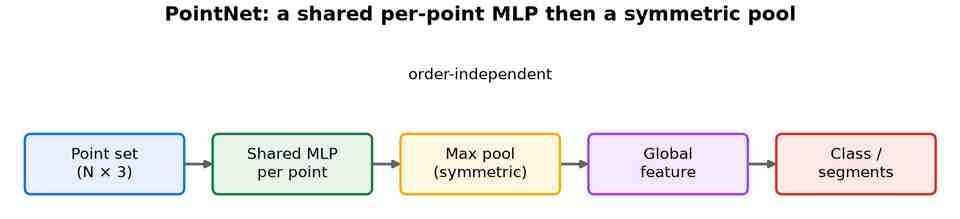
A point cloud is an unordered set of 3-D points — the raw output of a LiDAR sensor or depth camera — so the network must give the same answer whatever order the points arrive in. PointNet, in Fig 19, solves this by applying a shared MLP to every point independently and then collapsing them with a symmetric max-pool into a single global descriptor. The architecture is a direct application of the set-invariant principle, and its success demonstrated that deep learning on raw point clouds is possible without the explicit structure of a grid.
Origins and rise
PointNet introduced the shared-MLP-plus-symmetric-pooling recipe.[244] PointNet++ added hierarchical local grouping so the model could capture fine geometry, not just a global summary.[245] A different line, neural radiance fields (NeRF), fits a small network mapping a 3-D coordinate and viewing direction to colour and density, rendering photorealistic novel views.[246]
Convolutions on points
A global max-pool discards local geometry, so a family of models redefines convolution to act on an irregular neighbourhood of points. PointCNN learns an X-transformation that reorders and weights local points before a standard convolution, recovering the exploitation of spatial layout.[247] PointConv treats the convolution kernel as a continuous function of relative position, approximated by an MLP and reweighted by the local density so it can be applied at any coordinate.[248] KPConv instead places a set of learnable kernel points in space, letting each carry a weight that deforms to the local geometry.[249] SpiderCNN parameterises its filters as a family of polynomial functions over neighbours,[250] and PAConv assembles each kernel dynamically by mixing a learned weight bank with coefficients predicted from point positions.[251] Countering this trend, PointMLP showed that a plain residual MLP with a geometric affine module rivals these operators, suggesting elaborate local extractors are not strictly necessary.[252]
Graph-based point networks
Because a point cloud is naturally a neighbourhood graph, some models borrow directly from graph neural networks. Dynamic Graph CNN introduced EdgeConv, which builds a k-nearest-neighbour graph in feature space and recomputes it at every layer, so points that are semantically — not just spatially — close exchange information.[253] This dynamic recomputation lets the receptive field follow the shape's structure rather than a fixed spatial radius.
Point transformers
Self-attention is permutation-invariant by construction, making it a natural fit for unordered points. Point Cloud Transformer and Point Transformer both apply attention within local neighbourhoods, the latter using vector attention so each channel is weighted independently.[254][255] Stratified Transformer samples distant points sparsely and nearby points densely as attention keys, capturing long-range context for scene segmentation without quadratic cost,[256] while OctFormer uses an octree to sort points into windows of equal count, making attention scale to millions of points.[257]
Voxel and sparse-convolution backbones
A complementary route rasterises points into a 3-D grid so ordinary convolution applies. VoxNet was an early dense-voxel CNN for real-time object recognition,[258] but a dense grid wastes computation on empty space. Submanifold sparse convolution fixes this by storing and convolving only occupied voxels, keeping the active sites sparse,[259] and MinkowskiNet generalised sparse convolution to arbitrary dimensions, enabling high-resolution 4-D spatio-temporal networks.[260] For autonomous driving, SECOND brought sparse convolution to LiDAR object detection, greatly speeding up the voxel backbone.[261]
Implicit neural fields
Rather than store geometry as points or voxels, implicit models represent a shape as a continuous function learned by a network — a decoder in the spirit of the generative families. DeepSDF regresses the signed distance to the surface from any 3-D coordinate, so a whole class of shapes is compressed into one conditioned network.[262] Occupancy Networks predict instead whether a point lies inside or outside the object, giving a watertight surface at any resolution.[263] Convolutional Occupancy Networks add local convolutional features so the representation scales from single objects to whole scenes.[264]
Registration and odometry
Aligning two overlapping scans is the classical registration problem, and learned methods now replace hand-tuned iterative closest point. PointNetLK unrolls a Lucas–Kanade alignment on PointNet global features, back-propagating through the optimisation steps.[265] Deep Closest Point matches learned per-point features with attention and solves for the rigid transform in closed form,[266] and RPM-Net adds a learned annealing that makes matching robust to noise and partial overlap.[267] PointDSC then prunes wrong correspondences by enforcing spatial consistency, sharpening the final alignment.[268]
Applications
- LiDAR perception for self-driving cars and robotics.
- 3-D shape classification, part segmentation, and registration.
- Novel-view synthesis and 3-D scene reconstruction.
Strengths and limitations
| Strengths | Limitations |
|---|---|
| Operate directly on raw points, no voxelisation. | Global pooling can miss fine local structure. |
| Permutation-invariant by construction. | Scale poorly to very large scenes. |
| Compact and fast to run. | Sensitive to sampling density and noise. |